Here is a truth most wellness content skips: a professional fascia release session does a lot, but it wears off faster if you do nothing between appointments. The good news is that fascia stretching at home does not require a foam roller the size of a surfboard, a physio degree, or thirty minutes you do not have. A few targeted exercises done consistently make a real difference to how your body feels between sessions. Here is what actually works. Spoiler: none of it involves buying anything.
What Fascia Stretching Actually Does
Before getting into the exercises, it helps to understand what you are actually trying to achieve so you do not waste time on movements that look impressive but do not do much for the fascia specifically.
When the fascia is healthy and hydrated, it has a slight elasticity that allows muscles to slide smoothly against each other. When it tightens up, through sitting too long, moving too little, stress, old injuries, or just accumulated life, muscles start to drag against each other instead of gliding, and the result is the kind of stiffness and tension that does not fully resolve with regular stretching. The kind your physio looks at, sighs quietly, and says “how long has this been like this?”
Fascia stretching works differently to regular muscle stretching because the tissue responds to slow, sustained load rather than quick movement. If you stretch a muscle quickly, you are mostly working on the muscle itself. If you stretch slowly and hold for longer than feels natural, the fascia has time to respond and begin to lengthen. This is why a 90-second hold does more for the fascia than ten repetitions of the same movement, even though ten repetitions feels more like you are doing something.
Key Fascia Stretches and Release Exercises
These exercises work on the major fascial lines of the body, the areas where restriction tends to build up most commonly and cause the most downstream effects. None of them require equipment, though a yoga mat helps.
Slow hip flexor stretch
The hip flexors are where most people carry their fascial restriction, particularly anyone who sits at a desk. Tightness here pulls the pelvis forward and loads the lower back in a way it was not designed to sustain indefinitely.
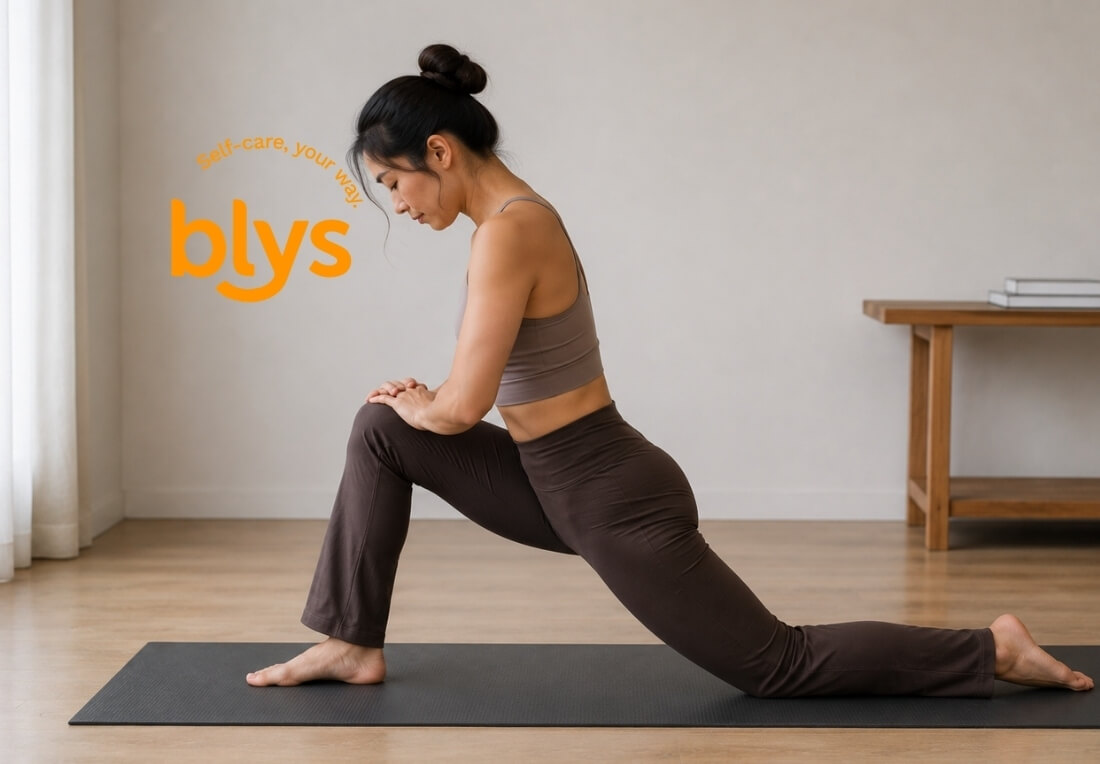
Get into a low lunge with one knee on the floor. Rather than pulsing or pushing into the stretch, just settle into it and breathe. Hold for at least 90 seconds, ideally two minutes. The goal is to let the front of the hip gradually release rather than force it open. You will likely feel something shift around the 60-second mark. That is the fascia responding.
Thoracic spine opening over a rolled towel
Most people’s mid-back is chronically compressed from sitting and looking at screens. This exercise targets the thoracic fascial line and creates space in the spine without any force required.
Roll a bath towel into a firm cylinder, lie on your back, and place the roll horizontally across your mid-back at about shoulder blade height. Let your arms rest open and your head relax back, and then do nothing for two minutes.
When that is done, move the towel one vertebra lower and repeat. The weight of your own body does the work, which means the exercise feels like you are barely doing anything while actually doing quite a lot. This is also the part where you fall asleep, which is fine because the towel will still be there when you wake up.
Standing forward fold with soft knees
This targets the entire posterior fascial line, the connective tissue running from the soles of your feet up the backs of the legs, through the glutes, along the spine, and over the skull. When this line is restricted, it shows up as tight hamstrings, lower back tension, and neck stiffness that seem unrelated but are actually connected.
Stand with feet hip-width apart and fold forward slowly, bending your knees as much as you need to. Then, let your head hang and your arms dangle.
Do not bounce, or try to touch the floor. Just hang there for two minutes and let gravity do the work. You can slowly straighten your legs as the tension releases, but do not force it.
Doorframe chest opener
The pectoral fascia is chronically shortened in most people and contributes to the rounded shoulder posture that causes upper back and neck pain. This is the easiest exercise on the list and also one of the most neglected.
Stand in a doorframe with your arms raised to about 90 degrees and your forearms resting on the door jambs. Lean your body forward gently until you feel a stretch across the chest. Hold for 90 seconds. Breathe into the front of the chest rather than holding your breath. Most people feel an immediate change in how their shoulders sit after doing this consistently for a few days.
Foot rolling
The plantar fascia at the bottom of the foot connects to the entire posterior fascial line mentioned above. Spending two minutes rolling a tennis ball under each foot every morning before you get out of bed is one of the simplest and most effective things you can do for whole-body fascial health. It sounds too easy to make a difference, but it really is not, and the tool you use matters more than you might expect.
Your feet have been holding up the rest of you this whole time, so, two minutes seems only fair.
What Fascia Stretching Can and Cannot Do
This section exists because there is a lot of overconfidence on both sides of this conversation. Some people treat foam rolling and stretching like they are equivalent to professional treatment. Others dismiss self-care entirely as useless between sessions. Both positions miss the point.
What fascia stretching can do at home is maintain the progress made in a professional session, reduce the rate at which restriction returns, and address mild tension before it becomes a persistent problem. When done consistently, it genuinely extends the benefit of professional treatment and means your therapist spends less time on catch-up work and more time on deeper release.
What it cannot do is replicate what a skilled therapist does with their hands. The sensitivity required to find and follow fascial restrictions, the sustained pressure applied to specific points, and the integration of the work across the whole body is not something a tennis ball and a doorframe can match. If you are dealing with chronic pain, restricted movement that is affecting your daily life, or tension that does not shift with consistent home practice, that is the signal to book a session rather than add more exercises to the list. More exercises is almost never the answer when the ones you have stopped working.
When to Book a Professional Session
The honest answer is: when home practice stops being enough. For most people, that means when the tension returns faster than it used to, when the exercises that were working stop producing the same result, or when a new restriction shows up that you cannot shift yourself.
A mobile fascia release session at home through Blys brings a local therapist to your door with everything needed to address what your home practice cannot reach. Available 7 days a week, 6 am to midnight across Australia.
Book a session and find out what your home practice has been working toward.