 Nurse burnout is one of the most serious challenges facing Australian healthcare right now and if you’re a nurse, you probably don’t need a study to tell you that. You’re living it. Working 10- or 12-hour shifts, rotating between days and nights, absorbing the weight of other people’s hardest moments, and still expected to show up sharp, compassionate, and fully present. That is a lot to carry.
Here’s what most burnout articles miss for shift workers specifically: standard self-care advice assumes you have a standard schedule. It assumes you’re free after 6pm, can book a fortnightly appointment, and have the energy after a late shift to drive somewhere and wait in a reception area. That’s rarely the reality. The most effective recovery options for nurses right now are the ones that come to you at home, on demand, and built around when you actually need them.
This article covers what nursing burnout really is, what’s driving it in the Australian healthcare context, how it connects to patient safety, and most importantly, what practical recovery actually looks like for someone working shifts. No generic tips. No nine-to-five assumptions.
What Is Nurse Burnout, And How Do You Know If You’re Actually Experiencing It?
Nurse burnout is a state of prolonged physical and emotional exhaustion that develops when the demands of caregiving consistently outpace the recovery and support available to you. The World Health Organisation classifies it as an occupational phenomenon something produced by working conditions, not a reflection of your character or capability.
It shows up in three distinct ways. First, emotional exhaustion: that bone-deep feeling of having nothing left to give. Second, depersonalisation emotionally distancing yourself from patients and colleagues as a psychological defence mechanism when you’re running on empty. Third, a reduced sense of personal accomplishment, where work that once felt meaningful starts to feel hollow.
The distinction that matters: this is not ordinary tiredness from a run of hard shifts. Those pass. Burnout is what sets in when rough shifts become the baseline when rest stops restoring you, when you dread going in rather than feeling ready.
In Australia, post-pandemic research has documented a significant rise in burnout and psychological distress across the nursing workforce, with many experienced clinicians stepping back from direct patient care entirely. If you recognise yourself in this description, you are far from alone and the evidence places the problem firmly with the system, not you.
Why Are Australian Nurses Burning Out? The Causes That Run Deeper Than One Bad Shift
The causes of nursing burnout are largely structural, not personal. Research published in peer-reviewed health journals consistently identifies the same cluster of conditions:
- Chronic understaffing and unsafe patient ratios: When you’re responsible for more patients than is clinically safe, every decision carries more risk and every shift feels like triage.
- Rotating shifts and irregular rosters: Night shifts, weekend rotations, and unpredictable scheduling disrupt sleep, circadian health, and social connection in ways that compound over months and years.
- Emotional labour: Holding space for patients and families through fear, grief, and acute distress is invisible work. It takes a real toll, and it’s rarely accounted for in any staffing model.
- Moral distress: Being required to make compromises in care due to resource constraints creates a specific psychological strain unique to healthcare workers.
- Low autonomy: Feeling like you have little say over your working conditions or clinical decisions is a consistent predictor of burnout across all sectors.
- Lack of recognition: When effort and expertise go unacknowledged, the internal motivation that sustains care work erodes gradually, then suddenly.
- Poor workplace culture: Hierarchical environments, unsupportive management, and interpersonal conflict accelerate exhaustion across entire teams.
The framing matters: structural factors drive burnout, not individual resilience levels. The response can’t only be “do more self-care” but that doesn’t mean individual recovery is pointless. It means recovery strategies need to be genuinely accessible, not aspirational.
Does Your Burnout Affect Your Patients? Here’s What the Evidence Actually Says
This is where burnout stops being a personal health issue and becomes a patient safety concern and the evidence is consistent.
Research links burnout in clinical nurses to higher rates of medication errors, reduced vigilance for patient deterioration, lower patient satisfaction, and increased risk of hospital-acquired infections. When you’re operating in a state of chronic depletion, the cognitive and emotional resources required for safe, attentive care are genuinely reduced.
In Australia, the downstream effect on workforce retention is becoming critical. Experienced nurses are exiting clinical roles faster than the system can replace them, creating a compounding cycle: fewer nurses, higher workloads, faster burnout, more attrition.
None of this is meant to add to the weight you’re already carrying. It’s here to make one point clearly: your recovery matters not as a personal luxury but as a direct investment in the care you’re trying to provide and your capacity to keep providing it long term.
What Does Self-Care Actually Look Like When You Work Rotating Shifts?
Most wellness advice is designed for Monday-to-Friday lives. If you’re finishing at 7am, mid-run of nights, or about to start a stretch of back-to-back late shifts, that advice doesn’t land. Here’s what does.
- Micro-recovery between shifts: Even 15 to 20 minutes of intentional rest (not scrolling) activates the parasympathetic nervous system and speeds physical recovery. Guided breathwork takes five minutes and works in a parked car before you drive home.
- Batch cooking on days off: Removing nutrition decisions from the post-shift window eliminates a real daily drain. Portable, protein-rich food keeps energy stable across long shifts without requiring any morning effort.
- Movement that fits your actual schedule: A walk, a home stretch routine, or bodyweight training requires no gym membership, no commute, and no fixed schedule. Consistency at a manageable level beats intensity that isn’t sustainable.
- Sleep hygiene for rotating shift patterns: Blackout curtains, a consistent pre-sleep sequence, a cool and quiet room, and screen-free wind-down time all make a meaningful difference. Your environment does a lot of the work if you set it up right.
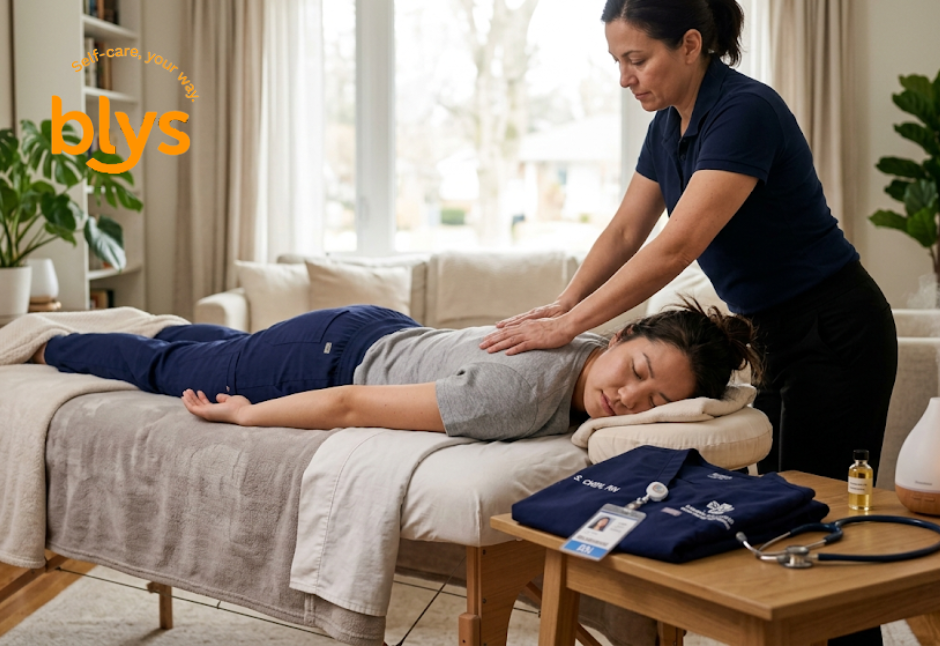
- At-home physical recovery: Booking a vetted, insured professional to come to your home is the only recovery format that actually removes the logistical friction shift workers face. No driving after a 12-hour shift. No waiting rooms. No appointments that need to be locked in three weeks ahead when you don’t know your roster yet.
- Scheduled peer time: Time with people who understand healthcare colleagues or close friends provides emotional processing that solo self-care can’t replicate. Book it deliberately rather than waiting for the right moment to appear.
If you’re a team leader or manager exploring meaningful wellness options for your whole department, at-home and on-demand formats are particularly well suited to staff who work irregular hours.
Why Clinic-Based Wellness Doesn’t Work for Shift Workers And What Actually Does
Here’s the problem with most professional wellness services: they’re designed for nine-to-five lives. Massage clinics close at 6pm. Physio books out weeks ahead. Yoga studios run fixed timetables that assume you’re free at the same time every week.
For shift workers, this creates a real and consistent access gap. But here’s the part most self-care guides miss entirely: it’s not just the hours. It’s the advance booking problem. When your roster changes week to week, you often can’t commit to a 6pm Thursday appointment booked three weeks ago because your schedule might not have been confirmed until two days prior. Traditional clinic booking requires certainty that rotating shift work simply doesn’t provide.
Providers you book through Blys can be booked same-day or next-day. That means you can schedule recovery once you actually know your shifts, not in advance of a roster that hasn’t dropped yet. It’s a fundamentally different model, and for shift workers, it’s the one that actually works in practice rather than in theory.
Through Blys, you can access a network of vetted, insured professionals across Australia remedial massage therapists, myotherapists, physiotherapists, and other allied health practitioners who come to your home at the time that suits you. You recover on your couch, not in a waiting room. You don’t add 40 minutes of commuting to a shift that already ran long.
If you want to build recovery into your schedule before a particularly demanding stretch, planning a wellness reset before the busy season hits is a practical way to start.
Take Care Of Yourself So You Can Keep Caring For Others
Nursing burnout is a serious occupational health issue, not a personal failing, and not something that gets better through endurance alone. The system-level change it requires takes time and collective advocacy. But while that work continues, protecting your own recovery is one of the most practical things you can do for your patients, your team, and your own longevity in a profession that genuinely needs you.
Low-friction, at-home wellness is built for lives that don’t fit standard service hours. Explore what’s available near you through Blys and start with whatever fits your next shift pattern.