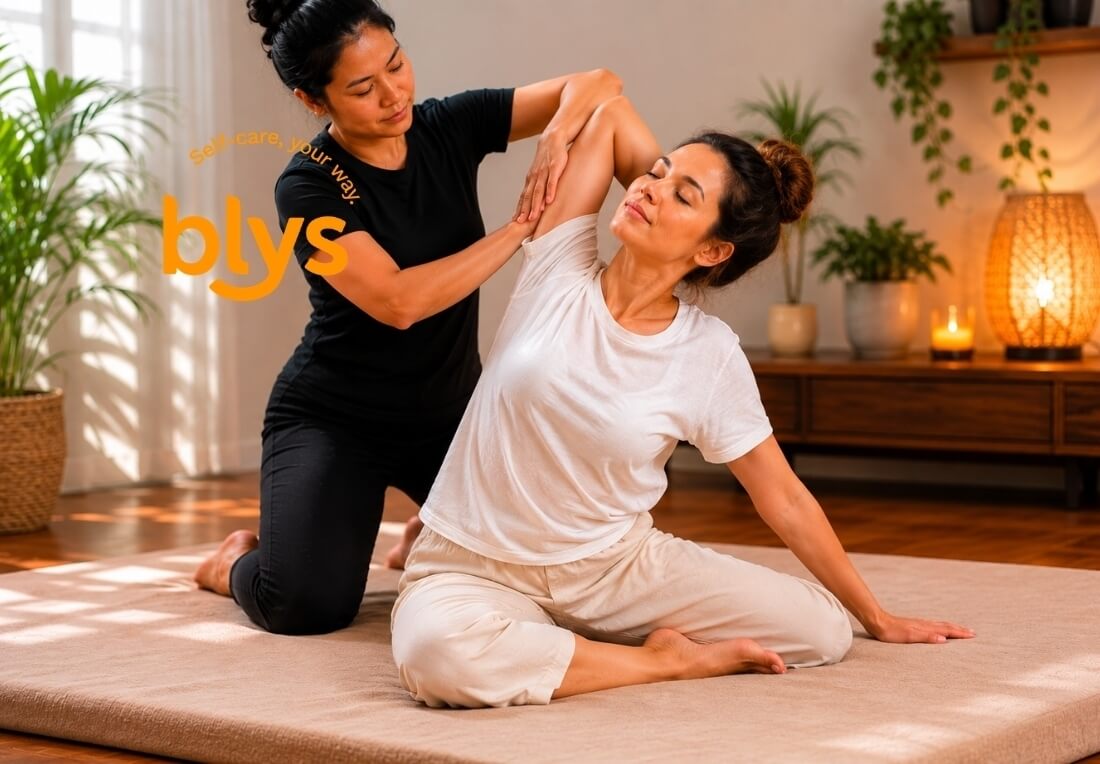
Most people who want to improve their flexibility try the same things: a few minutes of stretching before or after a workout, maybe a yoga class when the schedule allows. Progress is slow, motivation fades, and the stiffness they were trying to fix mostly stays in place. Thai massage for flexibility works differently, and the reason comes down to how assisted stretching interacts with the nervous system compared to stretching on your own.
What Assisted Stretching Does That Solo Stretching Cannot
When you stretch by yourself, two things limit how far you can go. The first is the muscle’s actual length. The second, and often more limiting, is the nervous system’s protective response, a reflex that kicks in to stop the muscle from being overstretched or torn. This reflex fires whether the muscle is genuinely at its limit or not, which is why most solo stretching plateaus quickly.
Assisted stretching changes this equation. When your therapist controls the movement and supports your body through the stretch, your nervous system receives a different signal. Because you are not generating the force yourself, the protective reflex is less likely to fire at the same threshold. The muscle can move further, be held there longer, and the nervous system gradually recalibrates what it considers a safe range.
This is not just a theory. A 2020 study in the Journal of Bodywork and Movement Therapies found that Thai massage produced real improvements in flexibility in participants compared to static stretching alone, with the assisted component responsible for the additional gains. Solo stretching does something, but assisted stretching does more.
How Thai Massage Targets Range of Motion
Thai massage for flexibility is not a single stretch applied to a single muscle. It works across the whole kinetic chain, which means your therapist is working on the connections between muscles and joints rather than treating each one in isolation.
A typical session targets the hips and hip flexors, hamstrings, thoracic spine, shoulders, and calves, all areas that most restrict movement in the body and that most people neglect in their solo stretching because the positions are hard to get into without support. The assisted stretches in Thai massage take each of these through their full comfortable range, held long enough for the muscle to actually release rather than just touch the edge and bounce back.
The acupressure component adds to this. Your therapist applies rhythmic pressure along the body’s energy pathways before and during the stretches, working on the tight spots that restrict movement even before the stretch begins. By the time a muscle is taken into a stretch, the surrounding tension has already been reduced, which allows the stretch to work at a deeper level than it could otherwise reach.
For people who train regularly, this is particularly relevant. Sports massage addresses muscle recovery and localised tension, but Thai massage for flexibility addresses movement patterns across the whole body, and the two complement each other well if improving range of motion is the goal.
Who Benefits Most from Thai Massage Stretching
Almost anyone with restricted movement benefits from Thai massage, but a few groups tend to notice the biggest shift.
People who sit at a desk for most of the day carry predictable patterns of tightness: shortened hip flexors, tight hamstrings, a stiff thoracic spine, and rounded shoulders. Thai massage addresses all four in a single session, which is why desk workers often describe the experience as a reset rather than just a massage.
Athletes and people who train regularly often find that strength work outpaces their flexibility work over time. Muscles get stronger and tighter, range of motion gradually decreases, and the body starts compensating in ways that eventually lead to injury. Thai massage flexibility work helps counteract this pattern before it becomes a problem.
Older adults dealing with the stiffness that comes with age respond particularly well to assisted stretching because the supported nature of the movement allows for progress that solo stretching makes difficult. A 2019 study on older adults found that regular Thai massage improved functional flexibility and balance, with participants reporting better ease of movement in daily life.
And then there are the people who have simply been meaning to sort out their flexibility for years and never quite gotten around to it. Thai massage is the option that does not require them to build a new habit or show up to a class. The therapist comes to them, does the work, and the results accumulate whether or not they ever touch their toes on their own. No judgement either way.
How Often to Book Thai Massage for Flexibility Benefits
A single Thai massage session can help you feel more flexible, but the biggest and longest-lasting improvements come with regular sessions. If you’re starting with a lot of stiffness, weekly sessions for the first four to six weeks can help you see results more quickly. After that, a session every two weeks is usually enough to maintain your progress and keep improving.
For athletes, a monthly Thai massage can support training and recovery, with extra sessions during busy training periods or before competitions. If you spend most of your day sitting at a desk, a session every three to four weeks can help reduce built-up tension and improve mobility without being difficult to fit into your schedule.
The simple truth is that some Thai massage is better than none, and regular sessions work better than occasional ones. Over time, the benefits build on each other, helping your body move more freely and comfortably.
Since consistency is key, having a therapist come to your home can make it easier to keep up with regular sessions. After all, it’s much harder to talk yourself out of a massage when it’s coming straight to your front door. Book a Thai massage at home through Blys, available 7 days a week, 6 am to midnight across Australia.