Most workplace stress programs have the same problem. They look good on paper, employees appreciate the gesture, and nothing much changes. The fruit bowl gets eaten, the meditation app gets downloaded and forgotten, and the ping pong table gets used twice in the first week and then mostly ignored.
This isn’t about effort, since most organisations genuinely want to help their people manage stress. The problem is that the most common approaches don’t actually address what stress does to the body. And until that changes, the numbers don’t move.
Why Most Workplace Stress Programs Fail
Stress is a physical experience, not just a mental one. Chronic stress raises cortisol, disrupts sleep, tightens muscles, and wears people down over time. Most workplace wellness programs treat it as a mindset problem, which is part of the picture, but not all of it.
According to Safe Work Australia, mental stress accounted for 16,800 serious workers’ compensation claims in Australia in 2023-24. That’s 11.5% of all serious claims, and it only counts cases serious enough to reach the compensation system. The everyday stress that quietly wears away focus, energy, and morale across most workplaces doesn’t show up in that number.
The organisations that actually make progress on stress are the ones that treat it as a whole-person problem. That means addressing the physical side, not just offering resources for the mental side.
What the Research Actually Shows About Stress Reduction
2024 systematic review published in Nature Human Behaviour combined 137 studies on touch interventions and found they are especially effective at regulating the body’s stress response, including cortisol. The reason is simple: physical touch activates the part of the nervous system responsible for rest and recovery, in a way that passive relaxation usually doesn’t.
It’s worth being honest about what this means. Massage is not a medical treatment for stress. What the research shows is that regular, skilled human touch helps the nervous system shift out of a stressed state and into a recovery state. For people carrying chronic work stress, that shift done consistently makes a real difference to how they feel, how they sleep, and how they show up at work.
This is the mechanism most corporate wellness programs skip. Not because it’s unknown, but because it requires actual human contact rather than an app.
The Physical Side of Work Stress in Australia
Stress and physical tension feed each other. People who are chronically stressed hold tension in their bodies, particularly in the neck, shoulders, and lower back. That tension increases discomfort, disrupts sleep, and makes the stress worse. It’s a cycle that doesn’t break on its own.
A 2024-2025 study on therapeutic massage for occupational stress found improvements in both physical symptoms, neck and shoulder pain, and reduced range of motion. This is consistent with what the broader research shows: regular massage supports physical recovery from work-related load, which reduces the physical dimension of stress over time.
For desk-based workers specifically, this matters a lot. Prolonged sitting creates predictable patterns of muscular tension that build up over months and years. Addressed early, they’re manageable. Left alone, they become the kind of chronic issues that lead to compensation claims.
Why At-Home Delivery Removes the Biggest Barrier for Remote and Shift-Based Workers
The most consistent finding in workplace wellness research is that access drives uptake. Programs that require employees to travel, book in advance, or rearrange their day get used by the people who need them least.
Remote workers, shift workers, parents, and employees outside the city face the biggest barriers to traditional wellness services. At-home delivery changes that. A therapist comes to the employee, wherever they are, which means the benefit works for the whole team rather than just the ones with a standard schedule.
This is increasingly relevant in Australia. Remote and hybrid work is not going away, and a wellness program that only works for people in the office on set hours is a benefit for a subset of your team, not the team.
How to Build Massage Into a Team Benefit
There are several practical ways organisations build massage and physical recovery into their workplace wellness programs through Blys.
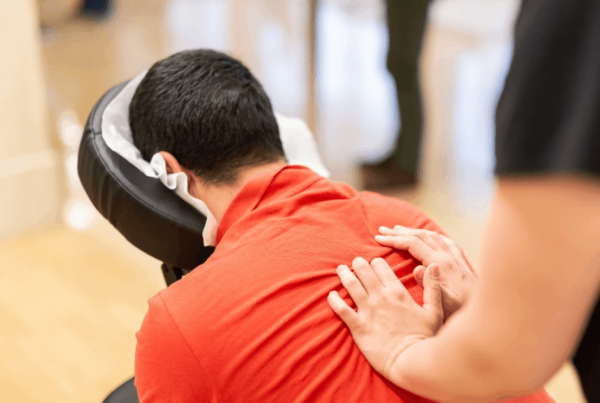
In-office chair massage is the most common entry point. Therapists come to the workplace and deliver 10 to 20-minute chair massages to employees throughout the day. It requires no preparation from employees, fits into a standard working day, and tends to generate strong uptake and positive feedback. It works particularly well as a regular team benefit, and as part of staff reward events.
For remote or distributed teams, individual in-home massage sessions through Blys can be offered as part of an employee wellness allowance or gifted as a team benefit via gift vouchers. Employees book at a time that suits them, a therapist comes to their location, and the administrative side is handled through the platform.
For larger organisations, custom employee wellness packages are available, including program design, scheduling coordination, and reporting on participation. For larger teams, custom corporate wellness packages are available depending on your team’s size and setup.
The Honest Case for Physical Recovery as a Workplace Investment
Unaddressed stress costs organisations money. It shows up in absenteeism, lost productivity, health claims, and turnover. The slower cost, the gradual loss of energy and focus across a team, is harder to measure but every manager has seen it.
Physical recovery through regular massage is not a complete solution to workplace stress. But it addresses a dimension of stress that most programs don’t touch, it produces results that employees notice and value, and it signals to the team that the organisation takes their physical wellbeing seriously, not just their mental health awareness.
For organisations ready to move past the fruit bowl, get in touch with our team.