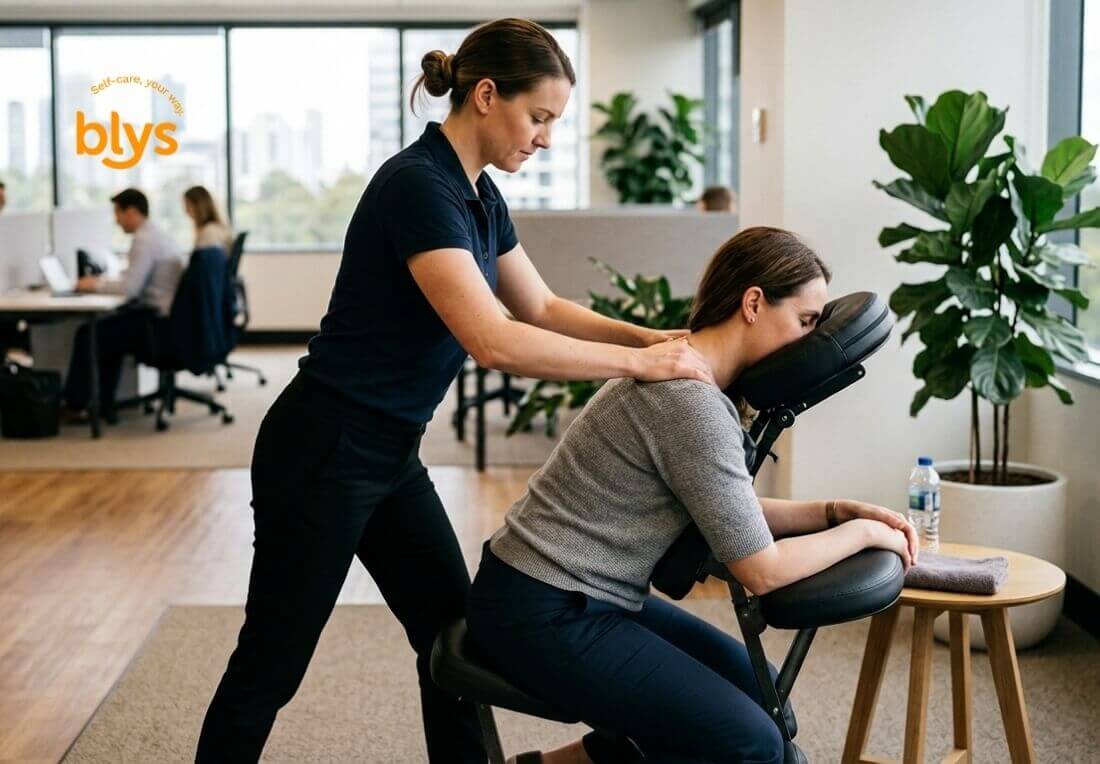
Most articles on this topic say something like “workplace wellness can be tax deductible when provided equally to all staff” and leave it there. That’s not wrong exactly, but it’s missing the part that actually matters, which is that equal provision has nothing to do with the tax treatment. Whether corporate massage is tax deductible in Australia depends on how your program is structured, how often sessions run, and what each session costs per person.
Here’s the honest breakdown, in plain English. For the practical side of running a corporate massage program, session types, and costs, that’s covered separately.
Corporate Massage FBT: Fringe Benefits Tax on Massage Explained
When a business pays for employee massage, it’s providing a fringe benefit. Corporate massage FBT is the framework that governs it, and the question of whether employee massage is tax deductible depends entirely on which exemptions apply, and the same applies to onsite massage tax deductible questions and chair massage programs. Fringe benefits have their own tax, Fringe Benefits Tax (FBT), which sits with the employer rather than the employee, and currently runs at 47%. The ATO’s FBT guide covers the full framework.
That sounds expensive, and it can be. But before you close this tab, there are two things worth knowing.
First, businesses that pay FBT can also claim an income tax deduction on the benefit cost and the FBT paid. So the net cost is lower than 47% suggests.
Second, and more usefully for most businesses: there are exemptions that remove the FBT liability entirely. The minor benefits exemption is the one that applies to most corporate massage programs.
The Minor Benefits Exemption: The Most Useful Pathway for Workplace Massage Tax Deduction
Under section 58P of the FBTAA, the minor benefits exemption for massage and other employee benefits applies when all three of these are true:
- The cost of the benefit is under $300 per employee per occasion (including GST).
- It’s provided infrequently and irregularly.
- It’s not a reward for services or performance.
For a one-off corporate wellness day where each person gets onsite massage costing under $300, the minor benefits exemption is the most relevant pathway here, and this exemption almost certainly applies. The benefit is under the threshold, it’s not recurring, and it’s not tied to anyone’s performance review.
When This Exemption Stops Working
A regular weekly or fortnightly massage program won’t qualify. The “infrequently and irregularly” requirement is the sticking point, if sessions are recurring and scheduled, the ATO treats the benefit as a standard fringe benefit rather than a minor one, and FBT applies.
Monthly sessions sit in a grey area. Whether they qualify depends on the specific structure of the program, which is why this is a question for your accountant rather than a blog.
The Exemption That Doesn’t Apply (But Often Gets Cited)
There’s a work-related preventative health care exemption under section 58M of the FBTAA that sounds like it should cover massage. It covers care that prevents or reduces the risk of a work-related illness or injury.
The catch is the definition of “care.” It only applies when care is delivered by or at the direction of a legally qualified medical practitioner or nurse. A massage therapist, however qualified and however therapeutic their work, doesn’t meet this definition unless they’re working under direct medical supervision as part of a prescribed treatment plan.
This exemption is mentioned a lot in corporate wellness marketing. It rarely applies to standard workplace massage programs.
The Otherwise Deductible Rule
There’s a third option worth knowing about. Under the “otherwise deductible” rule, the taxable value of a fringe benefit can be reduced if the employee could have claimed the cost as a tax deduction themselves.
For most employees getting massage as a wellness perk, this won’t apply, personal massage isn’t generally tax deductible for employees unless there’s a direct connection to income-earning activities. For an employee receiving massage as part of a medically directed rehabilitation program for a work injury, the picture might look different. But for standard corporate wellness programs, this rule rarely applies. But that’s a narrow situation, not a general rule.
What the FBT Numbers Actually Look Like
If FBT does apply to your program, the calculation works like this.
The ATO grosses up the benefit value to account for the fact that the employee hasn’t paid income tax on it. For most corporate massage benefits (Type 2), the gross-up rate is 1.8868. So a $100 massage has a grossed-up taxable value of $188.68, and FBT at 47% on that is approximately $88.68.
The business then claims an income tax deduction on both the $100 cost and the $88.68 FBT paid. At a 30% company tax rate, that deduction is worth around $56.60, which reduces the net FBT cost to around $32.
For a one-off wellness day that qualifies for the minor benefits exemption, none of this applies, the benefit’s simply FBT-free.
What This Means for Your Program
The structure of your corporate massage program determines the tax treatment. A quick summary:
One-Off Wellness Day (Under $300 Per Person)
Almost certainly FBT-exempt under the minor benefits exemption. No FBT return needed for these benefits, but keep records showing cost per person per occasion.
Regular Weekly or Fortnightly Program
FBT likely applies. The business pays FBT at 47% on the grossed-up value but can claim an income tax deduction on both the session costs and the FBT paid. Still worth running, many businesses find the retention and productivity outcomes justify the net cost.
Monthly Sessions
Grey area. Depends on program structure and how the ATO views frequency in your specific situation. Run it past your accountant before committing to a structure.
The Records You Need
If you’re relying on the minor benefits exemption, you don’t need to lodge an FBT return for those benefits. You should keep records showing the cost per employee per session and the dates of each session.
If FBT applies, the benefits go into your FBT return (which covers the April to March FBT year), and you’ll need records of the total value provided.
Always Check With Your Accountant
The framework described here reflects Australian tax law as at mid-2026, but individual circumstances vary and thresholds change. The FBT year runs April to March, and your specific program structure, session frequency, cost per person, how it’s documented, all affect the outcome.
An accountant familiar with your business is the right person to confirm the treatment. Employee massage tax deductible questions always come down to program specifics, not a general rule.
Corporate massage through Blys is available for one-off wellness days and regular programs across Australia. Blys provides per-session invoicing broken down by employee if you need it for your FBT records.
The cleaner answer on structure: run the minor benefits exemption where you can, keep your records, and confirm with your accountant before committing to a program frequency.
Enquire about corporate massage for your team through Blys, a qualified therapist comes to your office with everything needed.