Most conversations about workplace stress focus on how employees feel. This one is about what it costs. The numbers are significant enough that they belong in a budget conversation, not just a HR conversation.
Note: This blog is for general informational purposes only and does not constitute financial, legal, or medical advice.
What Workplace Stress Actually Costs Australian Businesses
Workplace mental health is estimated to cost Australian businesses up to $39 billion each year in lost participation and productivity, according to the NSW Government and the Black Dog Institute. That figure includes both absenteeism and presenteeism, which are two very different problems with very different price tags.
Safe Work Australia puts the cost of a poor psychosocial safety climate to Australian employers at approximately $6 billion per year. The cost of depression alone, through presenteeism and absenteeism, is estimated at $6.3 billion annually. These are not projections or estimates from industry bodies with a product to sell, but from the national workplace safety regulator.
For an individual business, the maths is harder to see but no less real. When a team is under sustained stress, output drops, quality slips, and recruiting and retraining costs start to accumulate. Most of this never appears on a leave report.
Absenteeism vs Presenteeism in Australian Workplaces
These two terms often get used interchangeably, but they describe very different problems and have very different costs.
Absenteeism is the one most managers notice. An employee calls in sick, their workload lands on someone else, and the immediate disruption is visible. Absenteeism costs Australian employers an estimated $33 billion a year, according to Scalesuite’s 2026 analysis of Australian workforce data.
Presenteeism in Australia costs more and is far harder to spot. It refers to employees who show up but are not functioning properly, because of stress, burnout, physical discomfort, or mental health struggles they’re pushing through rather than addressing. According to the same analysis, presenteeism costs Australian employers approximately $35 billion a year, making it the larger of the two problems. A report from Intellect found that Australia’s presenteeism rate sits at 44.4%, meaning close to half of the workforce is regularly at work but not fully productive.
The reason presenteeism costs more than absenteeism is that it’s invisible. An absent employee is a gap you can plan around. A present but struggling employee is a gap that looks like normal output until someone pays close attention.
The Productivity Loss That Doesn’t Show Up on Leave Reports
Presenteeism is the quiet drain that most leave management systems are not built to catch. Scalesuite’s 2026 data found that 37% of Australian employees practiced presenteeism in Q3 2025, working while unwell or disengaged, and that burnout is the primary driver of this in the short term, and of both absenteeism and resignation in the medium term.
Think about what that looks like day to day. An employee who is physically present but mentally running on empty takes longer to complete tasks, makes more mistakes, contributes less in meetings, and is more likely to snap at a colleague or drop the ball on something small that becomes a larger problem. None of this shows up on a timesheet, and all of it costs money.
By the time burnout is obvious, it has been building for months. The warning signs come first in the form of disengagement and reduced output, not absence.
There is also a compounding effect that rarely gets factored in. When high performers burn out and leave, the institutional knowledge they take with them, and the cost of replacing them, is rarely attributed to stress in any formal accounting. But the connection is there.
What Interventions Show ROI on Workplace Wellbeing
The business case for wellness investment has strengthened considerably in recent years. A 2024 randomised controlled trial found that a digital stress management intervention had a 77% return on investment from the employer perspective. A Harvard Business Review analysis found that for every dollar invested in employee wellness, medical costs fell by $3.27 and absenteeism-related costs fell by $2.73, a return of $6 for every dollar spent.
Companies that invest in wellness programs and resilience training have cut absenteeism by up to 30%, according to IMARC Group’s 2025 Australian Corporate Wellness Market analysis. The same research found that organisations with active health and wellness programs saw a 25% boost in productivity.
The warning, and it’s an important one, is that not all wellness investments produce these returns. Programs with low uptake produce low returns regardless of their design. The interventions that show the strongest results are the ones employees actually use, which means access and convenience are as important as the quality of the program itself.
Physical recovery plays a specific role here that most ROI analyses underestimate. Chronic physical tension is a direct output of prolonged stress, and it feeds back into cognitive function, sleep quality, and emotional regulation. Addressing it through regular massage, either in-office or via at-home delivery for remote teams, produces measurable improvements in the physical dimension of stress that apps and awareness programs cannot replicate.
How to Start Small Without a Large Wellness Budget
The organisations that get the best returns on wellness investment tend to start with one thing that employees will actually use, measure the impact, and build from there. A large budget is not the starting point. A high-uptake intervention is.
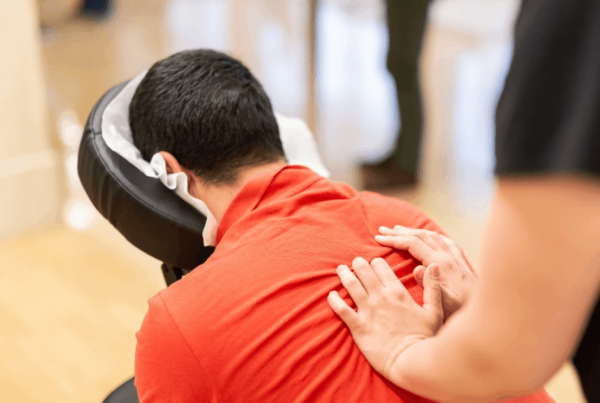
An in-office chair massage through the Blys platform is one of the most practical entry points for this reason. The setup cost is low, the uptake tends to be high because employees don’t have to go anywhere or do anything beyond engaging in a short session in their day, and the physical recovery benefit reaches the people who need it most, including those who would never prioritise their own wellbeing unless it was built directly into their working day.
Massage is the most research-backed option for stress and physical recovery, but it is not the only one worth considering. Onsite yoga and Pilates sessions give teams a structured way to move and reset during the day. A beauty or nail bar set up for a team event gives people something enjoyable and low-pressure that still signals the organisation is investing in their wellbeing. These options work particularly well as part of a broader wellness day or staff reward event, where the goal is participation and a genuine sense of being looked after rather than a single intervention.
For distributed or remote teams, in-home massage sessions and Blys gift vouchers extend the same benefit without requiring anyone to come into an office. An employee in a home office who hasn’t had a proper recovery day in weeks benefits just as much as someone in a Central Business District tower, but only if the benefit actually reaches them in a format they can use.
The cost of doing nothing is already showing up in your leave reports, your engagement scores, and in the output of people who are present but not really there. Starting with something that works, that employees will actually use, is how you begin to change that number.
If you want to understand what this looks like for your team’s size and setup, get in touch with our team.