The soreness that arrives the day after a hard workout, or more accurately the morning of the day after, when getting out of bed becomes its own training event, is delayed onset muscle soreness, also known as DOMS. Everyone gets it, nobody enjoys it, and the question of whether massage actually helps is a reasonable one that deserves a straight answer rather than a sales pitch.
Here’s what the evidence actually says about DOMS recovery massage, and what to do with it.
What DOMS actually is
DOMS isn’t damage in the way most people assume. It’s the body’s inflammatory response to the microscopic trauma that eccentric muscle contractions cause, which is the lengthening-under-load part of a movement, like the lowering phase of a squat or the landing phase of a jump. The tissue isn’t seriously injured; it’s adapting, and the soreness is part of that process.
The inflammation peaks at 24 to 48 hours after the effort, which is why the soreness often isn’t there immediately after training but is very much there the following morning. By 72 hours it’s usually starting to resolve on its own, and by day four or five it’s typically gone, whether you do anything about it or not.
DOMS doesn’t mean the workout was better
The soreness level has no reliable relationship with the quality of the training session. Beginners get more DOMS than experienced athletes doing the same workout because the tissue is less adapted to the load. Novel exercises produce more DOMS than familiar ones, and returning to training after a break produces noticeable DOMS even from light sessions. More soreness doesn’t mean more progress, it means the tissue encountered something unfamiliar.
DOMS reduces with repeated exposure
The repeated bout effect means that doing the same exercise again before the DOMS has fully resolved reduces the severity of the response the second time around. This is one of the reasons experienced lifters get less sore than beginners, not because they’re working less hard, but because the tissue has adapted to the specific demands of their training. Your body gets better at handling what you keep throwing at it.
What the evidence says about DOMS massage
The research on sore muscle massage is more positive than a lot of fitness content suggests. The most consistent finding across multiple reviews is that massage reduces perceived soreness from DOMS and may speed the return of muscle function, though the effect on the underlying inflammation is less clear.
What massage actually does
The most reliable effect is on how sore the muscles feel, which sounds like a small win but is actually a real one. If the soreness is limiting your ability to train, sleep, or sit down without making noises, reducing it has real value even if the tissue repair is happening at the same rate underneath. Most people who book a sports massage during DOMS report the area feels noticeably better during and after the session, and that the peak soreness window is shorter than it would have been.
The leading explanation is that massage reduces the inflammatory signalling driving the soreness sensation, improves local circulation, and activates the parasympathetic nervous system in a way that changes how the brain processes the pain signal. Whether you’re a physiology nerd or just someone who wants their legs to work again, the practical result is the same: less soreness, sooner.
What massage doesn’t do
Massage doesn’t speed up the removal of lactic acid. This is a persistent myth worth killing off, and lactic acid isn’t actually the cause of DOMS anyway as it clears within about an hour of exercise. Massage also doesn’t speed up the tissue repair process itself. The inflammation after hard training is an adaptive response, and suppressing it too aggressively, whether through ice, anti-inflammatories, or deep work immediately after the effort, may actually reduce the training adaptation you were chasing in the first place.
The honest version: massage for delayed onset muscle soreness is useful for managing the symptom rather than accelerating the underlying process. That’s still worth doing, especially if the soreness is affecting training frequency or just making everyday life annoying.
What to do alongside massage
Active recovery
Light movement, walking, easy cycling, a gentle swim, increases blood flow to the sore muscle and reduces perceived soreness more consistently than lying on the couch hoping for the best. It doesn’t need to be a session; 20 to 30 minutes of easy movement the day after a hard effort is enough to make a real difference. If you want the full picture on active recovery for gym-goers, that’s the deeper read.
Sleep and nutrition
Sleep is when the actual tissue repair happens, and under-sleeping after a hard training session extends the soreness timeline more reliably than almost anything else. Protein intake in the 24 to 48 hours after training supports the repair process. Neither of these is as satisfying as booking a massage, but both have strong evidence behind them and cost nothing.
Heat
Heat increases blood flow and reduces the perceived pain of soreness, which is why a warm shower or heat pack on a sore muscle feels like it’s doing something, because it is. It doesn’t accelerate repair, but it does reduce the discomfort, which is often what people actually want.
Cold water immersion
Ice baths and cold showers reduce perceived soreness reliably, with one catch: they suppress the inflammatory response that drives the adaptation. For athletes whose priority is performance, the soreness reduction is probably worth it. For people training for muscle growth, the evidence suggests skipping the ice bath and taking the soreness instead.
When to book relative to your workout
Timing matters more than most people realise for getting anything useful out of a delayed onset muscle soreness massage.
Not immediately after training
The first few hours after training, while the acute inflammatory phase is running, isn’t the right window for deep work. The tissue is in an active inflammatory state and aggressive massage during this period can actually increase soreness rather than reduce it. A light, flushing session is fine; deep tissue work isn’t.
24 to 48 hours after: the sweet spot
The 24 to 48 hour window is when the soreness is at or near its peak and when DOMS massage produces the most noticeable relief. This is when the inflammatory response is active but not so acute that massage makes it worse, and the window where a session has the best chance of shortening how long the soreness sticks around.
If the soreness is affecting your next training session, reducing it at the 24-hour mark gives the muscles more time to settle before you need them again. That’s probably the most practical reason to book in this window rather than waiting it out.
48 to 72 hours after: still useful
By this point the soreness is usually starting to resolve on its own. A massage here is still useful for reducing residual tension and helping the final stages of recovery move faster, but the urgency is lower. If your schedule only allows this window, it’s still worth doing.
Before your next hard session
If DOMS from one session is overlapping with the next scheduled hard effort, a sports massage between the two reduces the residual tension and gives the second session a better starting point. It’s not clearing the DOMS magically, it’s reducing the muscular tightness that accumulated soreness creates so the next session doesn’t feel like punishment from the first rep.
The soreness is coming regardless of what you do. The question is just how long you want it to stay.
Book a sports massage at home through Blys, available 7 days a week, 6 am to midnight across Australia.
Book the Session That Makes Tomorrow’s Workout Possible →
Frequently asked questions
Does massage help with DOMS recovery?
Yes, with some nuance. The most consistent finding in the research is that massage reduces how sore the muscles feel and may shorten the window of peak soreness. It doesn’t accelerate the underlying tissue repair or clear lactic acid (which isn’t the cause of DOMS anyway), but reducing the symptom has real value if the soreness is affecting training or daily function.
What is the best massage for delayed onset muscle soreness?
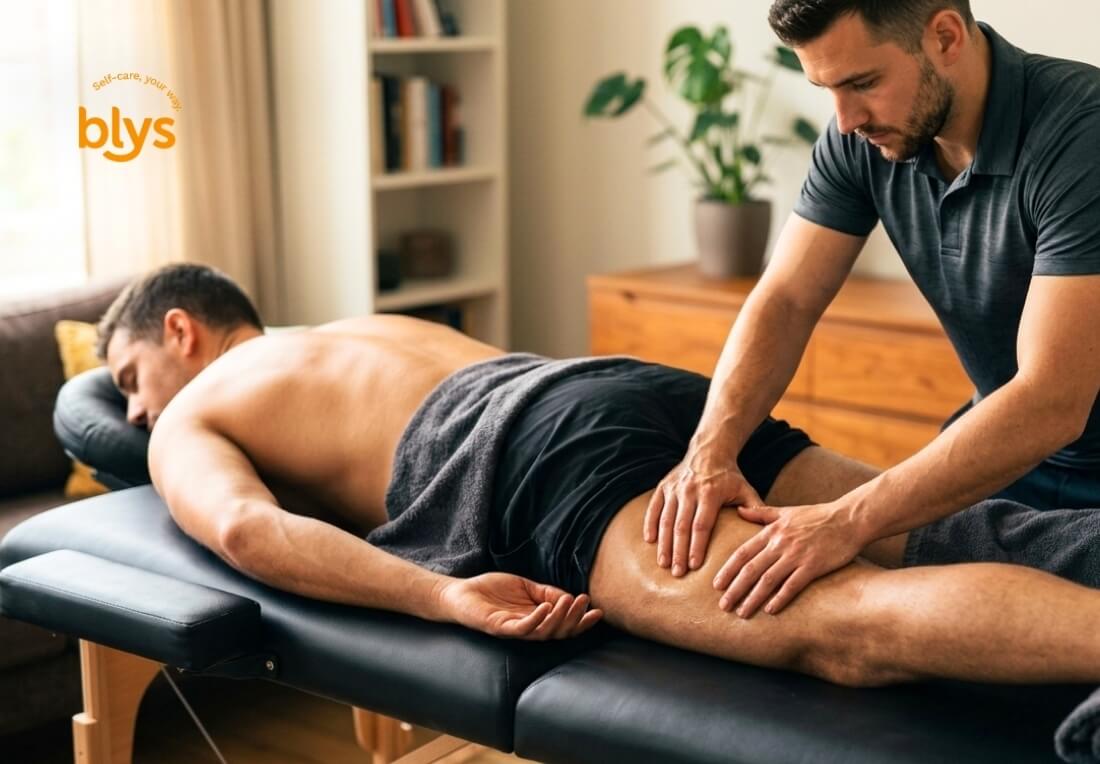
Sports massage is the most common choice for DOMS recovery because it’s built around muscle groups under load and focuses on improving circulation and reducing tension in specific areas. The pressure is firm but not aggressive, and your therapist adjusts based on how the tissue feels on the day.
When should I get a sore muscle massage after training?
The 24 to 48 hour window after a hard session is the sweet spot. Booking too soon, in the first few hours while the acute inflammation is at its peak, can increase soreness rather than reduce it. By 24 hours the tissue is ready for hands-on work and that’s when the relief is most noticeable.
Does massage help with DOMS or make it worse?
It depends on timing and pressure. Deep tissue work in the first few hours after training can make soreness worse. In the 24 to 48 hour window, at an appropriate pressure, massage reliably reduces perceived soreness. The key is not going too hard too soon.
How long does DOMS last without massage?
Most DOMS resolves on its own within 72 to 96 hours regardless of what you do. Massage, active recovery, and heat can shorten the peak soreness window, but the process is largely self-resolving. The main reason to do something about it is if the soreness is affecting training frequency or quality of life in the meantime.