Australia has one of the most active populations in the world, with more than 14 million adults playing sport or doing physical activity weekly, from weekend AFL players to recreational cyclists and gym-goers who understand the value of recovery. If you’re passionate about sport, movement, and helping people perform and recover at their best, figuring out how to become a sports massage therapist in Australia is a natural starting point.
Unlike some countries, Australia doesn’t require a government licence to practise massage, but there is a clear, well-established pathway through nationally recognised training and professional association membership. This guide walks you through qualifications, earnings, building a sports-focused client base, and how mobile practice works in the Australian context.
Do You Need A Licence To Become A Sports Massage Therapist In Australia?
No occupational licence is required by law to practise massage therapy in Australia. Instead, the pathway runs through nationally recognised training and professional association membership. Most therapists complete either a Certificate IV in Massage Therapy (an entry-level qualification) or a Diploma of Remedial Massage (HLT52021), the more advanced qualification that covers sports massage technique, trigger point therapy, myofascial release, and clinical assessment.
What Training Do You Need?
The Diploma of Remedial Massage requires a minimum of 200 hours of supervised clinical practice, alongside coursework in anatomy, physiology, pathology, and soft tissue assessment. Course duration typically runs 12 to 18 months through a Registered Training Organisation (RTO), a government-accredited training provider. Sports massage-specific technique is usually built into the diploma curriculum rather than offered as a separate qualification.
One genuine advantage of the Australian system worth knowing about upfront: because these qualifications are nationally recognised, you can train in one state and take up work opportunities in another without needing to requalify or upskill, a real point of difference from countries where licensing sits at the state or provincial level and doesn’t automatically transfer.
Completing your Diploma of Remedial Massage through an RTO is what makes you eligible to register as a health fund provider and join a recognised professional association afterward.
What Association Should You Join?
Once qualified, joining a professional association is the next essential step, both for insurance and for credibility with clients. The main bodies are Massage & Myotherapy Australia (MMA), the Australian Traditional Medicine Society (ATMS), the Australian Natural Therapists Association (ANTA), and the Association of Massage Therapists (AMT). Membership typically requires a national police check and evidence of your qualification, and it’s what makes you eligible for private health fund rebates, letting your clients claim back part of the cost through their health insurance.
How Long Does The Whole Process Take?
From enrolment to your first paid booking, most people move through this pathway in 12 to 18 months, matching the typical Diploma of Remedial Massage duration through an RTO. Since there’s no separate licensing exam to schedule and sit the way there is in the US, association registration after qualifying tends to move quickly, generally a matter of weeks once your national police check clears and your paperwork is submitted. Health fund provider registration typically follows soon after, once your association membership is confirmed.
Maintaining Your Membership Over Time
Association membership isn’t a one-time step. Most bodies, including MMA and ATMS, require ongoing continuing professional education (CPE) hours each renewal cycle to keep your membership, and by extension your health fund provider status and insurance, active. Requirements vary by association, so it’s worth checking the specific CPE hours and acceptable course types for whichever body you join, since not all training automatically counts toward renewal.
How Do You Attract Sports And Athletic Clients In Australia?
Once you’re qualified and registered, the next challenge is reaching active clients who need what you offer. Australia has a genuinely enormous athletic population, from weekend AFL and netball players to marathon runners, CrossFit members, and recreational cyclists.
Here’s what most guides on this topic don’t mention: the best clients aren’t found through ads, they’re found in communities. Local running clubs, CrossFit boxes, and recreational sporting leagues are full of motivated people who train consistently and actively recommend providers they trust. Getting embedded in one or two of those communities early on is one of the most effective moves a new mobile therapist can make.
Specialise visibly. Positioning yourself around a specific sport or training style makes you memorable and searchable. “Sports massage for triathletes in Melbourne” or “post-game recovery massage for AFL players in Perth” cuts through in a way a generic listing won’t.
Build relationships with gyms, coaches, and physiotherapists. Gyms, sporting clubs, and allied health clinics are natural referral partners. A professional introduction to a physiotherapist or personal trainer working with active clients can establish a meaningful referral pipeline.
Be present at sporting events. Local fun runs, triathlons, and sports carnivals are excellent places to introduce yourself. Post-event recovery massage puts your work in front of people actively experiencing the discomfort you can address.
Leverage social proof. Client reviews, especially those naming a specific sport or result, are the most compelling marketing you have.
Create content that demonstrates your knowledge. Short video clips, posts about common injuries in specific sports, or explainers on recovery techniques position you as a knowledgeable resource. Active people are constantly searching for this kind of information, and content that helps them builds trust before they ever book a session.
Account for seasonality. Australia’s sporting calendar creates real seasonal shifts in demand. AFL and NRL winter seasons drive one wave of injury-prevention and recovery bookings, while cricket, tennis, and outdoor running dominate the summer months. Building your marketing calendar around these shifts, rather than treating demand as constant year-round, helps you plan client outreach more effectively.
Research indexed on PubMed documents the evidence base for sports massage in areas including recovery from delayed onset muscle soreness (DOMS) and pre-competition preparation, a useful reference when positioning your services with athletic clients or healthcare referrers.
Building Specialised Skills Beyond Your Diploma
Qualifying is the entry point, not the ceiling. Once you’re working, therapists who build the strongest reputations with athletic clients tend to keep adding specific skills. Cupping therapy and kinesiology taping are both commonly requested by name, and dry needling courses (where you’re eligible) sharpen your ability to work with more complex presentations. None of these are required to practise, but each makes you a more complete resource for athletic clients, and continuing education in this direction typically counts toward your association’s CPE renewal requirements as well.
What Can You Expect To Earn?
Earnings vary considerably based on how you work and where. Current SEEK salary data places massage therapist roles in Australia at around $75,000 to $80,000 a year on average for employed positions, while self-employed and mobile-platform work can offer stronger earning potential once your bookings become steady. Massage therapist salary expectations, job demand, and the physical realities of the work go into more depth than fits here.
What Does Mobile Sports Massage Practice Look Like In Australia?
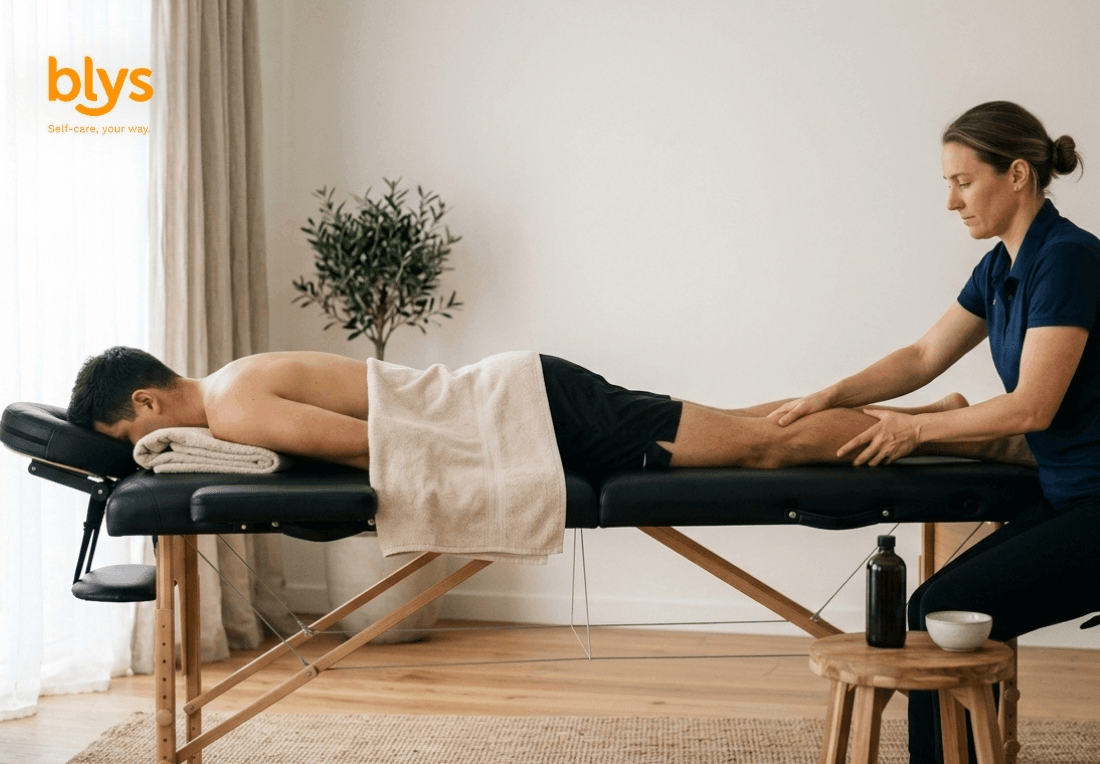
Mobile massage is well-established in Australia, and the on-demand model, where clients book a therapist to come to their home, hotel, or gym, is growing steadily. For sports massage in particular, mobile service removes the post-training friction of driving to a clinic when a client is tired, sore, or pressed for time.
The Financial Case For Going Mobile
Without clinic rent or overhead, more of each session rate stays with you. You control your travel radius, going only where it makes practical sense. At-home clients also rebook far more consistently than clinic clients, stabilising your income faster and with less ongoing hustle, and the format suits the rhythm of sports work naturally, pre-event prep, post-training recovery, and weekly maintenance all fit into a home setting without adding stress to your clients’ schedules.
Setting Up Your Mobile Kit
The practical requirements are a quality portable massage table, professional linens, and the tools relevant to your technique. Most mobile therapists in Australia work by car, so table weight and storage efficiency are worth considering when choosing equipment.
Pricing And Logistics
Mobile work justifies premium pricing relative to clinic work, since you’re bringing the service to the client. Factor in drive time and fuel costs when setting your rates, and consider a travel fee for appointments beyond a certain radius.
Working Across States
Because your qualification and association membership are nationally recognised, moving between states doesn’t create the same registration headaches it can in countries with state-by-state or provincial licensing. That said, health fund provider arrangements and specific local council requirements can still vary, so it’s worth confirming any state-specific rules before establishing a mobile practice in a new area. The practical setup steps for becoming a massage therapist sit alongside what’s covered here.
At A Glance: Australian Sports Massage Qualification And Association Framework
| Stage | Requirement | Governing Body | Notes |
| Education | Certificate IV or Diploma of Remedial Massage (HLT52021) | RTO (Registered Training Organisation) | Diploma includes 200+ clinical hours, nationally recognised |
| Professional association | MMA, ATMS, ANTA, or AMT | Industry associations | Required for insurance and health fund eligibility |
| Health fund provider status | Application after qualifying | Private health insurers | Lets clients claim rebates |
| Insurance | Professional liability | Via association membership | Required for gym, event, and mobile work |
| Continuing education | CPE hours per renewal cycle | Association-specific | Required to maintain membership and provider status |
How Blys Helps Mobile Sports Massage Therapists Find Clients In Australia
Building a consistent client base from scratch takes time. Connecting with a platform like Blys can accelerate that process significantly, particularly in the early stages of your independent practice, or when you’re expanding into a new area.
Blys connects professional, insured providers with clients across Australia who are actively looking for sports and remedial massage at home or at their preferred location. The platform takes care of matching, scheduling, and payment processing, which means you spend less time on admin and more time doing the work you trained for. Sports massage bookings through Blys range from single sessions to recurring clients building recovery into their regular training routine.
The Australian Athletic Market Is Underserved And That’s Your Opportunity
Australia’s sports and wellness market is large, active, and genuinely underserved when it comes to mobile, expert-level soft tissue therapy. For therapists who invest in solid training, join a recognised association, build their clinical skills, and connect with the right clients and platforms, a rewarding and financially sustainable career in sports massage is absolutely achievable.
Frequently Asked Questions
Do I need a government licence to practise sports massage in Australia?
No. There’s no government licensing requirement, but you do need a recognised qualification and professional association membership to work legally, get insured, and become eligible for health fund rebates.
Can I specialise in sports massage without a separate qualification?
Sports massage technique is typically built into the Diploma of Remedial Massage rather than requiring a separate qualification, so you can begin working with athletic clients once you’ve completed your diploma and joined an association.
Do I need experience before working with athletes?
Not formally, but many new therapists find it easier to build confidence with general clients first, since athletic clients often expect a provider who can speak knowledgeably about training loads and recovery science from day one.
Is sports massage physically demanding as a long-term career?
It can be, particularly if you’re doing firm-pressure work all day. Many experienced therapists manage this by varying their caseload across techniques, maintaining their own physical conditioning, and pacing their schedule to avoid burnout.